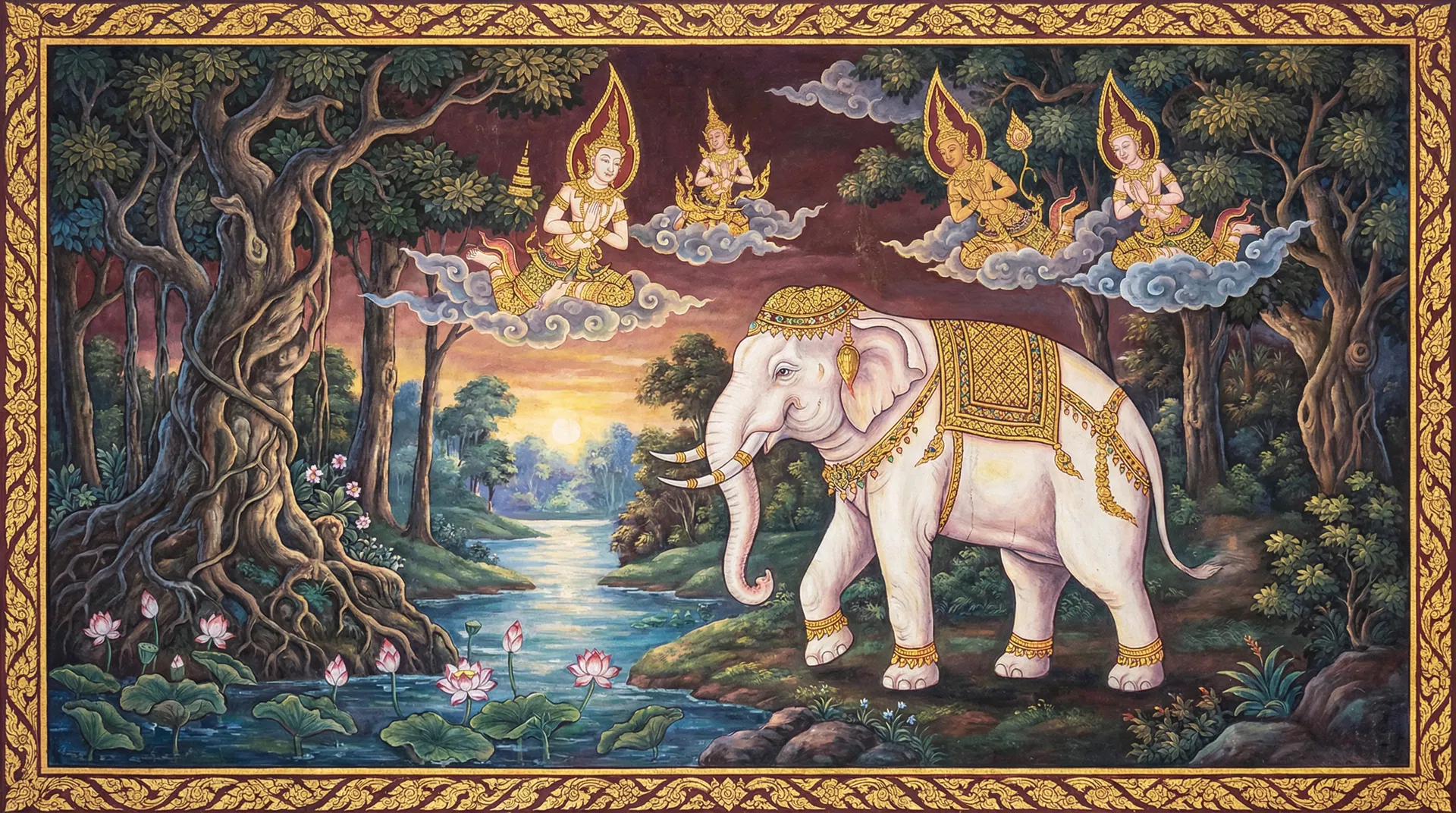
Nimi Jataka
Nimi Jataka
Long ago, in the heart of the magnificent city of Mithila, ruled a just and benevolent king named Nimi. His reign was a golden age, marked by prosperity, peace, and unwavering adherence to righteousness. King Nimi, a man of profound wisdom and compassion, was deeply devoted to the practice of generosity and upheld the moral precepts with utmost diligence. His kingdom thrived, his people were happy, and his reputation for virtue spread far and wide.
One day, the great god Sakka, king of the devas, descended from his celestial abode to visit King Nimi. Sakka, observing the king’s exemplary conduct and the serene atmosphere of his kingdom, was deeply impressed. He appeared before Nimi in a dazzling display of divine radiance, announcing, 'O King, your virtues shine as brightly as the sun. I have come to offer you a boon, anything your heart desires, for you have earned it through your merit.'
King Nimi, ever humble, bowed his head in reverence. 'Great Sakka,' he replied, 'I am content with my life and my kingdom. I desire no personal gain. However, if you insist, I would ask for a boon that would benefit not only myself but all beings.' Sakka, intrigued, inquired, 'What boon do you seek, O King?'
Nimi’s eyes sparkled with earnestness. 'I wish,' he declared, 'that the heavens be opened to all virtuous beings. Let the path to the celestial realms be paved with good deeds, so that those who follow the path of righteousness may attain the bliss of the gods. Let this be my boon: that the principles of Dharma be universally understood and practiced, leading all beings to happiness both in this life and in the next.'
Sakka was astonished by the king's selfless wish. 'Your wish is noble, King Nimi,' he proclaimed. 'Though it is beyond my power to grant such a universal transformation, I shall bestow upon you the knowledge of the heavenly realms and the path to reach them. You shall become a guide for mortals, teaching them the way to attain divine happiness through their own actions.'
With these words, Sakka imparted to King Nimi a profound understanding of the celestial realms, the nature of karma, and the virtues that lead to spiritual liberation. He revealed the intricate workings of cause and effect, the rewards of generosity, compassion, ethical conduct, and the cultivation of wisdom.
King Nimi, now imbued with divine knowledge, returned to his kingdom with a renewed sense of purpose. He gathered his people, from the humblest farmer to the highest minister, and began to teach them the profound truths he had learned. He spoke of the importance of selfless service, of speaking kind words, of abstaining from harm, and of cultivating a mind free from greed, hatred, and delusion.
He established institutions dedicated to charity and relief, ensuring that the poor and the sick were cared for. He encouraged open dialogue and honest counsel, fostering an environment where truth and integrity flourished. He himself lived by the principles he preached, his actions a living testament to the Dharma.
As Nimi taught, his people listened with rapt attention. They saw the wisdom in his words and the purity in his example. They began to embrace the teachings, transforming their lives and their society. The kingdom of Mithila became a beacon of righteousness, a place where virtue was not merely a concept but a way of life.
News of King Nimi's teachings and the flourishing state of his kingdom reached even the heavens. Sakka, observing from above, was filled with admiration. He saw that while he could not directly open the heavens for all, King Nimi, through his wisdom and compassion, had indeed paved the way for his people to ascend through their own merits.
One day, as King Nimi grew old, he felt the call of a higher existence. He had fulfilled his duty as a king and as a teacher. With a peaceful heart, he retired from his worldly responsibilities and, through the immense merit he had accumulated, he ascended to the celestial realms, not as a mere mortal visitor, but as a respected and revered being among the devas. He continued to guide and inspire those who sought the path of righteousness, his legacy echoing through the ages.
The story of King Nimi spread far and wide, a timeless reminder that the path to true happiness and celestial bliss lies not in magical interventions, but in the diligent cultivation of virtue, compassion, and wisdom within one's own heart and actions.
— In-Article Ad —
💡Moral of the Story
The path to true happiness and spiritual elevation is paved by one's own virtuous actions, guided by wisdom and compassion.
Perfection: Generosity (Dana), Morality (Sila), Wisdom (Panna)
— Ad Space (728x90) —
More Jataka Tales You May Enjoy
 86Ekanipāta
The Great Vanga Jataka
Once upon a time, in the glorious city of Savatthi, while the Supreme Buddha resided at Jetavana Mon...
💡 True compassion lies in the willingness to sacrifice one's own well-being for the benefit of others, and such selfless acts can bring about miraculous positive change.
 368Pañcakanipāta
MAHAPADUMA JATAKA
MAHAPADUMA JATAKAIn the ancient Kingdom of Mithila, ruled a king named Dighiti, a benevolent monarch...
💡 Envy and ambition are destructive forces that lead to heinous crimes and immense suffering. Truth and justice, though sometimes delayed, will ultimately prevail. True royalty is characterized by wisdom, compassion, and the ability to admit and atone for one's mistakes.
374PañcakanipātaMahādhammapāla Jātaka
Mahādhammapāla JātakaIn the verdant land of Kasi, where the sun cast a golden hue upon rolling hills...
💡 Deceptive gifts and false alliances often mask hidden agendas. True strength and victory are achieved through righteousness, wisdom, and genuine preparedness.
 536Mahānipāta
Mugapakkha Jataka
The Tale of the Mute Prince In the ancient kingdom of Mithila, nestled amidst rolling hills and verd...
💡 True wisdom and leadership are not always expressed through words. Silence can be a powerful testament to inner understanding, compassion, and enlightenment. Actions and presence can speak louder than any speech.
 379Chakkanipāta
Kumbha-jātaka
Kumbha-jātakaIn a serene monastery nestled on the slopes of a gentle hill, lived a community of monk...
💡 True skill and service are not merely about outward performance or confidence, but about complete awareness, humility, and a deep respect for the task and its surroundings. Pride can be a greater source of failure than lack of ability.
 411Sattakanipāta
Gambhira-Jataka
Gambhira-JatakaIn the ancient city of Mithila, nestled amidst lush emerald forests and sparkling riv...
💡 True treasure lies not in material wealth, but in wisdom, knowledge, and inner peace. Greed blinds individuals to the real value of life, leading to suffering and dissatisfaction.
— Multiplex Ad —